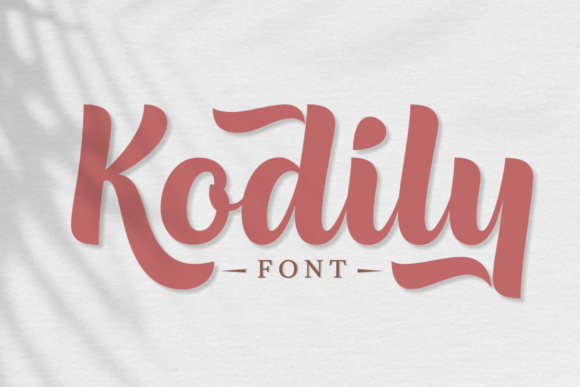
Kodily: A Bold Script Font for Editorial Charm
It started with a simple task—redesigning the header for my seasonal lifestyle blog. I wanted something warm, intentional, and quietly confident—not flashy, but full of presence. That’s when I opened my font library and scrolled past dozens of delicate scripts until Kodily appeared. Kodily is a bold, eye-catching script font, and right away, I felt its weight and rhythm settle into place. Thick and beautiful, these characters don’t whisper; they invite. They hold space without shouting. As a Script Handwritten typeface, Kodily brings tactile warmth to digital layouts—like ink pressed just so onto textured paper.
Kodily for Wedding Invitations and Elegant Branding
I tested Kodily first on a set of wedding guide templates—soft watercolor backgrounds, minimalist layouts, hand-drawn botanical accents. Here, Kodily for wedding invitations felt effortless. Its generous strokes and confident curves gave names and dates a gentle gravitas, while still feeling personal and human. Unlike thinner scripts that risk disappearing at small sizes or on fabric prints, Kodily holds its shape beautifully—even in embroidery mockups or letterpress proofs. As a Fonts choice for elegant branding, it pairs naturally with a refined serif (think Adobe Garamond or EB Garamond) for body text, letting the script shine where it belongs: in titles, monograms, and envelope addressing. No ligatures needed—just clean, confident letterforms that feel handmade, not algorithmic.
Kodily for Recipe Ebook Covers and Chapter Openers
When designing a small-batch recipe ebook—think rustic sourdough starters, slow-cooked stews, and handwritten ingredient notes—I reached for Kodily for recipe ebook covers. Its thickness gives immediate visual anchoring against soft food photography, and its vintage-leaning character echoes the time-honored craft behind each dish. For chapter openers, I used Kodily at 36–48pt in a single line (“Spring Greens,” “Late-Night Cookies”) over muted linen textures. It worked because Kodily is a bold, eye-catching script font that doesn’t compete with imagery—it complements it. Just remember: reserve Kodily for display use only. It’s not built for long paragraphs or mobile captions, but as a Script Handwritten accent, it adds soul to every title page and section break.
Kodily for Printable Planners and Wall Art Quotes
Last month, I designed a printable gratitude planner—lined pages, subtle gold foil accents, gentle margins. For the cover and weekly affirmations (“You are enough,” “Breathe deeply”), Kodily for printable planners delivered exactly what I hoped for: warmth, intention, and quiet authority. Because Kodily’s characters are thick and beautifully balanced, they print crisply on home printers and scale cleanly for wall art quotes—even at 12x16” poster size. When exporting PDFs, I embedded the font and checked glyph coverage: standard Latin characters, basic punctuation, and common alternates were all included. As with any Fonts purchase, I reviewed the license before adding it to client-ready templates—yes, it covers commercial use, including digital downloads and physical printables.
Kodily for Newsletter Headers and Social Media Graphics
For my biweekly newsletter—a mix of slow-living tips, book recommendations, and seasonal reflections—I swapped out my old sans-serif header for Kodily for newsletter headers. The shift was subtle but meaningful. Readers told me the new look felt more “like you”—more grounded, more personal. On social media graphics, especially Instagram carousels and Pinterest quote cards, Kodily’s boldness ensures legibility even when scaled down or overlaid on busy backgrounds. It’s not a workhorse font—but as a Script Handwritten highlight, it creates instant recognition. Paired with a friendly, airy sans serif (like Inter or Lato) for body copy and captions, Kodily becomes the signature touch—the first thing your eye meets, and the last thing it forgets.
Kodily for Vintage-Themed Designs and Fabric Prints
A few weeks ago, I collaborated on a small-run textile collection—linen napkins, cotton tea towels—with botanical motifs and soft sepia tones. Kodily for vintage-themed designs was the natural fit. Its generous x-height and open counters kept letterforms clear when screen-printed at medium scale, and its slight bounce added movement without sacrificing elegance. I avoided tight tracking and stuck to uppercase for short phrases (“Gather,” “Sip Slowly”)—letting Kodily’s natural rhythm breathe. As a Fonts option for fabric prints, it proves that boldness and beauty aren’t opposites—they’re partners. Just be sure to test export settings: TTF files rendered cleanly across design platforms, and the font loaded smoothly in both Canva and Affinity Designer.
Kodily for Logos and Brand Identity Systems
When sketching logo concepts for a new ceramicist client—earth-toned glazes, hand-thrown mugs, studio-based storytelling—I tried three scripts before landing on Kodily for logos. Its thickness gave the mark stability, while its organic flow preserved the maker’s voice. Used alone (no icon), centered over a simple tagline in a neutral sans serif, it communicated craft, care, and continuity. As part of a broader brand identity system, Kodily works best as a primary display element—not for navigation or product labels, but for the name itself, packaging stamps, and website hero text. Because it’s a Script Handwritten font with strong visual personality, it builds instant distinction without needing extra decoration.
Practical Notes Before You Use Kodily
- Licensing: Confirm commercial rights cover your use case—ebooks, templates, client work, and digital downloads are all supported.
- Pairing: Balance Kodily’s richness with a highly readable serif or clean sans serif for body text and UI elements.
- Readability: Best at 24pt and up on screen; avoid using below 18pt in PDFs or mobile layouts.
- Formats: Includes OTF and TTF—compatible with major design tools and web-safe via @font-face (with proper licensing).
- Multilingual: Supports Western European languages; verify extended glyphs if working with accented characters.