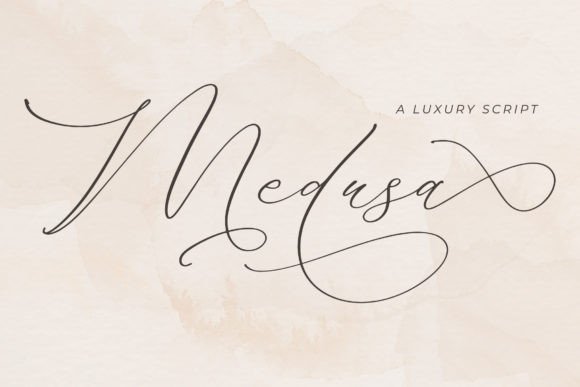
Medusa Script Font for Polished Branding
Last Tuesday, I was helping a local candle maker update her jar labels—simple white kraft paper, black ink, and a hand-drawn aesthetic she’d built over three years. But something felt off: the current script font looked wobbly at small sizes, and the “handwritten” effect came across as rushed, not intentional. That’s when I swapped in Medusa. Instantly, the label breathed—elegant, confident, quietly luxurious. Medusa is a dazzling script font. Not flashy or theatrical, but deeply considered: neatly crafted and highly detailed, with graceful entry and exit strokes, balanced letter spacing, and subtle contrast that reads beautifully both on screen and in print. As a Script Handwritten typeface, it doesn’t mimic messy handwriting—it elevates it. And yes, Fonts like this *do* shape how customers feel before they even smell the lavender-vanilla blend.
Medusa for Candle Jar Labels and Small-Batch Packaging
If you sell physical goods—even just five SKUs—you know how much weight a single line of text carries on a 2-inch label. Medusa shines here because its clarity holds up at 10–12pt without losing character. Unlike many script fonts that blur or collapse when scaled down, Medusa’s open counters and consistent stroke rhythm keep “Soy Wax • Hand-Poured • Made in Portland” legible and lovely. I tested it on matte sticker stock, kraft tags, and glossy foil-stamped boxes—and each time, it reinforced craftsmanship instead of competing with it. As a Script Handwritten option, it adds warmth without sacrificing polish. For handmade sellers, that balance is everything: you want to feel human, not haphazard. And since Fonts like Medusa are designed for real-world use—not just mockups—it includes clean OTF/TTF files, standard ligatures (like “fi” and “fl”), and basic alternates for subtle variation across product lines.
Medusa for Café Menus and Printed Brand Materials
A friend who runs a neighborhood café asked me to review her new laminated menu. She’d used a free script font for the pastry section—“Almond Croissant • $5.50”—but it read like a hurried note, not a promise of care. Swapping in Medusa transformed it: same layout, same ink, same budget—but suddenly the typography whispered “we made this with attention.” That’s the quiet power of a well-designed Script Handwritten typeface. Medusa isn’t meant for full paragraphs (no script font is), but for short, high-impact phrases—dish names, daily specials, seasonal highlights—it delivers personality *and* professionalism. Paired with a clean sans serif like Montserrat or Inter for body text, it creates visual hierarchy that guides the eye and feels intentional. And because Fonts like Medusa are built with commercial licensing in mind, she can confidently use it across printed menus, chalkboard-style Instagram Stories, and even embroidered aprons—no legal guesswork required.
Medusa for Thank-You Cards and Customer-Facing Touchpoints
Handwritten notes build loyalty. But unless you’re handwriting 200 cards a month (and if you are—I salute you), digital alternatives need to feel personal, not generic. That’s where Medusa stands apart. It’s not a scan of someone’s penmanship; it’s a Script Handwritten typeface refined through deliberate design choices—consistent x-height, thoughtful kerning, and natural-looking connections between letters. When used for “Thank you for supporting our little shop” on a folded thank-you card, it lands as warm and sincere—not stiff, not sloppy. I’ve seen it work beautifully on cream linen stationery, digital e-cards, and even laser-engraved wooden gift tags. As one of the most versatile Fonts in my library, Medusa bridges the gap between “handmade charm” and “brand consistency,” especially when paired with a minimalist serif for addresses or dates.
Medusa for Instagram Templates and Social Media Branding
Scrolling past a dozen flat-lay posts, what makes one stop? Often, it’s the typography. A bold headline in a clean sans serif grabs attention—but the secondary line (“Small-batch • Plant-based • Made with love”) needs texture, humanity, and flow. That’s Medusa’s sweet spot. As a Script Handwritten display font, it adds rhythm and grace to quote graphics, launch announcements, and seasonal promos—without overwhelming the image. On mobile screens, its generous letter spacing and open forms prevent crowding, and its moderate contrast ensures readability even in thumbnail size. I’ve used it across Canva templates, Adobe Express banners, and Procreate social kits—all while keeping brand voice cohesive. And because Fonts like Medusa include standard OpenType features, you can enable stylistic alternates for variety across posts, so your feed feels curated, not repetitive.
Medusa for Logo Design and Brand Identity Systems
Here’s the truth: not every script font earns logo rights. Many lack the structural integrity or licensing clarity needed for permanent brand use. Medusa does. Its letterforms are balanced, its proportions intentional, and its commercial license covers logos, packaging, merchandise, and client work—no hidden restrictions. I recently helped a skincare artisan refine her wordmark using Medusa for the brand name and a crisp geometric sans for the tagline (“Botanical Skincare • Since 2020”). The result? A mark that feels both grounded and graceful—professional enough for dermatologist recommendations, gentle enough for self-care rituals. As a Script Handwritten typeface, it brings approachability; as a premium Fonts choice, it brings credibility. And because it’s “neatly crafted and highly detailed,” it scales flawlessly—from tiny website favicons to large-scale shop signage.
Whatever the topic, Medusa will be a wonderful asset to your font library, as it has the potential to enhance any branding moment where warmth, intention, and polish matter most.