Monkey Smile: A Fun and Friendly Handwritten Script Font for Campaigns
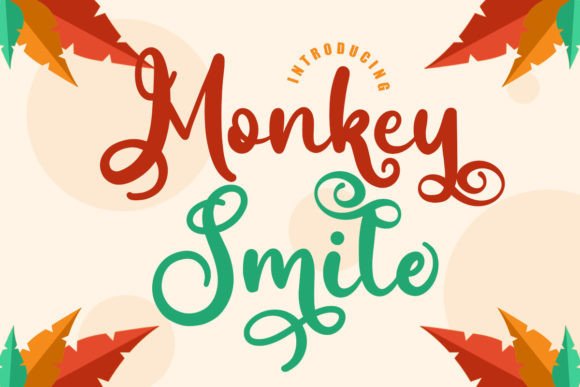
It’s 3:47 p.m. on launch day — I’m finalizing the Instagram carousel for a new online course series called *“Creative Breakthroughs.”* The first slide needs to stop scrollers mid-feed: warm, human, inviting — not corporate, not stiff, not overdesigned. I open my font library, scroll past the usual suspects, and land on Monkey Smile. Within seconds, “Your First Creative Breakthrough Starts Here” locks in — soft curves, playful rhythm, just enough personality to feel like a real person wrote it. That’s when it clicks: Monkey Smile isn’t just another Script Handwritten option — it’s a campaign-ready tone-setter.
Monkey Smile for Instagram Story Covers and Reels Thumbnails
Monkey Smile shines brightest where attention is fleeting and emotion is non-negotiable. On Instagram Stories and Reels covers — especially those with light overlays or soft gradients — its neatly crafted letterforms hold up beautifully at small sizes. Unlike some Script Handwritten fonts that blur or collapse on mobile previews, Monkey Smile maintains clarity thanks to its high level of detail: generous spacing, consistent stroke contrast, and intentional exit strokes that guide the eye. I used it for a “Sneak Peek Friday” series — pairing it with a clean sans serif (like Inter or Poppins) for subtext — and noticed how much faster people paused on the thumbnail. Not because it’s loud, but because it feels intentionally kind. It signals approachability without sacrificing polish — critical for course launches, creative tool promos, or small business announcements.
Monkey Smile for Pinterest Quote Graphics and Digital Ad Headlines
When designing Pinterest quote pins or static digital ads (especially for lifestyle, education, or wellness audiences), Monkey Smile adds warmth without clutter. Its friendly energy works well over textured backgrounds, muted photography, or even subtle watercolor overlays — no need to add drop shadows or outlines to boost legibility. As a Fonts asset, it performs best as display text: headlines, callouts, short taglines (“You’ve Got This,” “Start Small. Stay Curious.”). It’s not built for body copy or dense bullet points — and that’s by design. In one ad set promoting a downloadable worksheet bundle, we used Monkey Smile only for the main headline and paired it with a neutral serif (like Lora) for supporting text. The result? Stronger visual hierarchy, quicker message absorption, and zero readability complaints across devices. Just remember: avoid placing it over busy patterns or low-contrast dark-on-dark combos unless you adjust tracking and size deliberately.
Monkey Smile for YouTube Thumbnail Titles and Webinar Banners
YouTube thumbnails live or die by their top-third text — and Monkey Smile delivers there, too. Its rounded terminals and gentle bounce make it highly scannable even at 120px tall. For a recent webinar banner titled *“Design Your First Brand Kit (No Experience Needed)”*, we set the headline in Monkey Smile at 68pt, tracked +40, and placed it over a soft beige gradient. No outline, no stroke — just confident, friendly presence. Because it’s a Script Handwritten font with strong internal consistency, it reads as one cohesive phrase rather than disconnected letters — crucial when viewers glance for under two seconds. Bonus: it pairs effortlessly with modern sans serifs for secondary text (e.g., date/time in Montserrat), creating a balanced, professional-but-personal look that stands out in crowded feeds.
Monkey Smile for Branded Template Packs and Email Promo Headers
If you’re building Canva templates, Notion dashboards, or email promo headers for creative clients, Monkey Smile is a smart addition to your Fonts toolkit. Its “wonderful asset to your font library” status comes from versatility — not universality. It works across topics (as the description notes), but lands strongest when the goal is connection, not authority. Think: a printable planner cover, a workshop sign-up banner, or an email header announcing a seasonal sale (“Summer Spark Sale — 25% Off!”). We tested it in a branded template pack for freelance designers and found users consistently chose it for title slides and section dividers — never for footers or fine print. Important practical note: before licensing Monkey Smile for client work or digital products, always verify commercial use rights, check for included alternates or ligatures (it has both), and confirm file formats (OTF/TTF support is standard). Also worth scanning for multilingual character coverage if your audience spans beyond English-speaking markets.
When Monkey Smile Isn’t the Right Script Handwritten Choice
Not every campaign moment calls for playfulness — and that’s okay. Monkey Smile isn’t ideal for formal brand guidelines, legal disclaimers, data-heavy reports, or long-form landing page copy. Its charm lives in brevity and intention. Skip it for tiny captions (<14px), ultra-narrow columns, or situations demanding strict typographic neutrality (e.g., finance app UI, medical webinar banners). And while it’s highly detailed, it’s not a decorative script — so don’t force it into ornate monograms or logo lockups expecting extreme customization. Use it where handwriting energy serves the message: warmth, invitation, creativity, ease. That’s where Monkey Smile earns its place — not as background filler, but as a quiet, confident voice in your Fonts lineup.