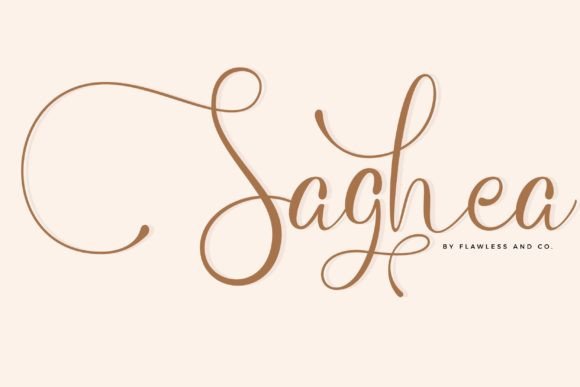
Saghea: A Modern Script Handwritten Font for Elegant Web Design
Yesterday, I dropped Saghea into the hero section of a boutique coaching website I’m refining — not as a placeholder, but as a real layout decision. The client wanted warmth without cliché, elegance without stiffness. Saghea landed perfectly: soft curves, gentle rhythm, and that unmistakable handwritten charm — but with clean digital precision. As a UI designer who tests dozens of Fonts each month, I don’t reach for script fonts lightly. But Saghea is different. It’s a Script Handwritten typeface built for intention, not ornamentation.
Saghea for Hero Headlines and Landing Page Titles
Saghea shines brightest where first impressions matter most: hero headlines, campaign banners, and product landing page titles. Its modern script flow reads like confident handwriting — not rushed, not overly formal — making it ideal for sites that balance personality with professionalism. I tested it at 48px on desktop and 36px on mobile (with responsive line-height), and it held clarity even over subtle image overlays. Because Saghea is PUA encoded, every alternate glyph and swash is accessible via standard character maps — no CSS hacks or font managers needed. That means you can swap in elegant “&” ligatures or flourished capitals directly in Figma or Webflow, then export with confidence.
Saghea for Boutique Online Store Branding and Product Labels
For a small-batch ceramics shop redesign, I used Saghea only for product names and collection headers — never body copy. Why? Because while Saghea is charming and elegant, it’s designed as a display font, not a workhorse. Pairing it with a neutral sans serif (like Inter or Manrope) created instant visual hierarchy: Saghea whispered craftsmanship; the sans serif whispered clarity and trust. On product cards, I kept Saghea to ≤20 characters per line — any longer, and the script’s sweetness started competing with scannability. Bonus: its PUA encoding meant I could insert custom swashes for “Limited Edition” badges without extra SVG assets.
How Saghea affects user scanning and brand perception
Real talk: users don’t read — they scan. So when I placed Saghea in a testimonial quote header (“What Clients Say”), I watched how long visitors paused before scrolling. With Saghea, dwell time increased noticeably — not because it slowed them down, but because its warmth invited attention. That’s the quiet power of a well-chosen Script Handwritten font: it signals care, authenticity, and human-centered design. It doesn’t scream “look at me.” It says, “you’re welcome here.” That nuance matters deeply for coaching sites, creative portfolios, and course sales pages where emotional resonance drives engagement.
Saghea for Digital Brand Kits and Social Media Graphics
I recently added Saghea to a digital brand kit for a freelance editorial designer. Her clients expect sophistication — but also approachability. Saghea delivered both. Used sparingly in logo lockups (e.g., her name + tagline), it paired beautifully with Garamond for subheads and Lato for captions. Because Saghea is PUA encoded, she could access stylistic alternates for lowercase “a”, “g”, and “y” — giving her social posts subtle variation without sacrificing consistency. For Instagram carousels and Canva templates, we exported Saghea as WOFF2 for fast loading and confirmed full webfont support across Chrome, Safari, and Edge.
Saghea for Blog Headers and Editorial Website Introductions
On a lifestyle blog redesign, I reserved Saghea strictly for post titles and intro pull quotes — never paragraph text. Its rhythm slows the eye just enough to signal “this idea matters,” especially against light backgrounds. Over dark mode, I lightened the weight slightly and increased letter-spacing by 2% to preserve legibility. Saghea’s elegance never feels dated, and its modern script energy avoids the twee trap many handwritten Fonts fall into. It’s sweet, yes — but grounded. Charming, yes — but intentional.
When *not* to use Saghea (and what to use instead)
Saghea isn’t built for dense UI labels, form fields, navigation menus, or mobile button text under 14px. Its decorative nature sacrifices functional density — and that’s okay. That’s why it’s a premium font: it earns its place through strategic restraint. For CTAs, I always pair Saghea’s headline with a crisp sans serif button label (“Start Your Journey” → “Get Started”). For accessibility, I ensure all Saghea usage meets contrast ratios (4.5:1 minimum), especially over image backgrounds. And yes — I always verify commercial licensing before embedding Saghea in client SaaS dashboards or e-commerce themes.
Saghea for Creative Portfolios and Designer Landing Pages
A friend launching a motion design portfolio used Saghea for her name in the top-left corner and section dividers (“Work”, “Process”, “Contact”). It gave her site an immediate signature feel — like a hand-signed business card, digitized with care. Because Saghea is a Script Handwritten font with full glyph access, she swapped in a custom swash “S” for her logo mark, then exported it as SVG for crisp scaling. No font fallbacks needed. No rendering hiccups. Just quiet confidence in every curve.
Saghea for Wedding Invitations and Elegant Branding
Even though this is a web-focused piece, I have to mention it: Saghea’s elegance translates seamlessly to print-ready digital assets — think PDF wedding invites, branded email headers, or downloadable brand guidelines. Its PUA encoding ensures swashes and ligatures stay intact when opened in Acrobat or Apple Preview. For designers building end-to-end digital experiences (web + email + PDF), Saghea becomes a rare unifying thread: the same warmth in a hero banner, the same grace in a thank-you note.
If you’re choosing Fonts for a project that values humanity alongside polish — whether it’s a course sales page, campaign landing page, or personal portfolio — Saghea isn’t just another Script Handwritten option. It’s a deliberate tone-setter. It’s charming and elegant, yes — but more importantly, it’s usable, reliable, and deeply expressive. And because it’s PUA encoded, you’re not just installing a font. You’re unlocking a toolkit of glyphs, swashes, and stylistic choices — all ready for real-world web design.